
How to Check State College Criminal History
A sound State College search begins with the event, not just a name. A police narrative, court docket, custody entry, and PATCH response answer different questions. If paperwork names State College Police, ask that department for the report. If the goal is to follow charges or learn the outcome, search the Unified Judicial System portal and use the correct magisterial district. A current custody question goes to Centre County Correctional Facility or VINELink. PATCH is the statewide repository product.
Use this order to avoid asking one office for another office's file:
- Confirm whether State College Police, Penn State Police, or another agency investigated.
- Request the incident or crash record from that agency through its stated channel.
- Use the county court finder, then search UJS for the correct State College MDJ docket.
- Check Centre County custody through the correctional facility or VINELink when booking status matters.
- Use PSP's PATCH or subject-only Access and Review when a Pennsylvania repository record is the actual need.
Searchers should keep the incident number, OTN, full name, and filing date when available. Those identifiers reduce false matches. They also help link a police event to its later court file without assuming that an allegation became a conviction.
State College Court District Split
One State College address can lead to MDJ 49-1-01 or MDJ 49-3-05. The split follows precinct geography, so choosing a court from the city name alone can miss a case. Centre County's address-based district court finder is the safest first step. Enter the relevant address, note the court number, and use that court in the UJS search.
MDJ 49-1-01 is at 131 South Fraser Street, Suite 5, State College, with phone 814-231-1420. MDJ 49-3-05 is at 121 South Pugh Street, with phone 814-861-7406. Both list weekday hours of 8:00 a.m. to 4:00 p.m. A docket in either office still needs to be read for the incident location and charging agency. Court geography is not proof that State College Police made the arrest.
The official Fraser Street court page shows the local court setting. The captured page below helps identify the proper county source before relying on a name match.
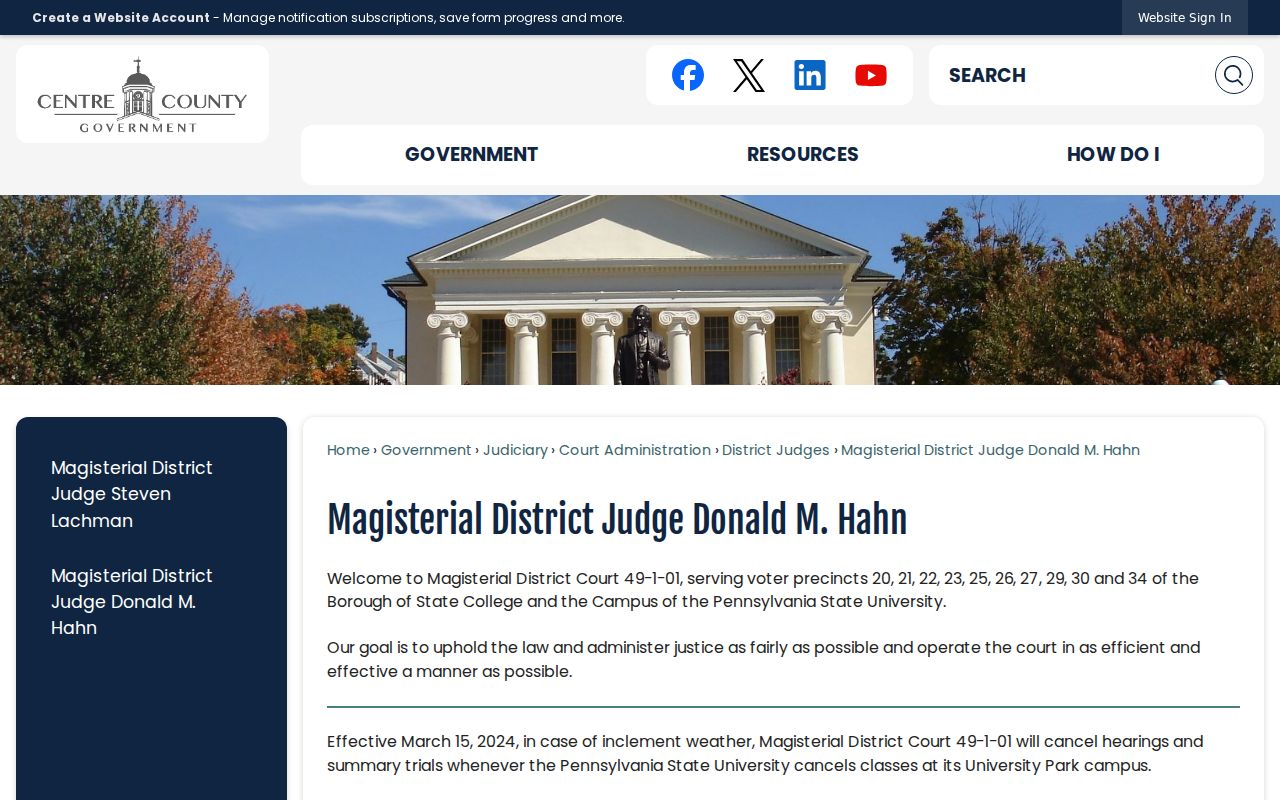
That district detail matters because an accurate State College criminal record search must begin with the court that actually received the complaint.
The State College Police Department
State College Police provides round-the-clock police service to the borough and, by agreement, to College and Harris townships. Its official profile describes about 55 sworn officers and 11 nonuniformed staff in Patrol, Detective, and Community Relations and Professional Standards functions. This three-area service footprint is important. An SCPD report does not by itself prove an event happened inside borough limits.
The records contact is 243 South Allen Street, State College, PA 16801; 814-234-7150; policerecords@statecollegepa.us. Inspection and duplication hours are listed as 8:00 a.m. to 5:00 p.m. weekdays. The department's Traffic/Warrant/Evidence section handles evidence, warrant service, and special-event planning. A person asking about an active warrant should not treat an informal response as permission to approach anyone or as a certified court record.
The official State College Police page is pictured below. It establishes the city-specific department source and helps prevent requests from being sent to the county Sheriff, which does not serve as the borough's general investigative records office.
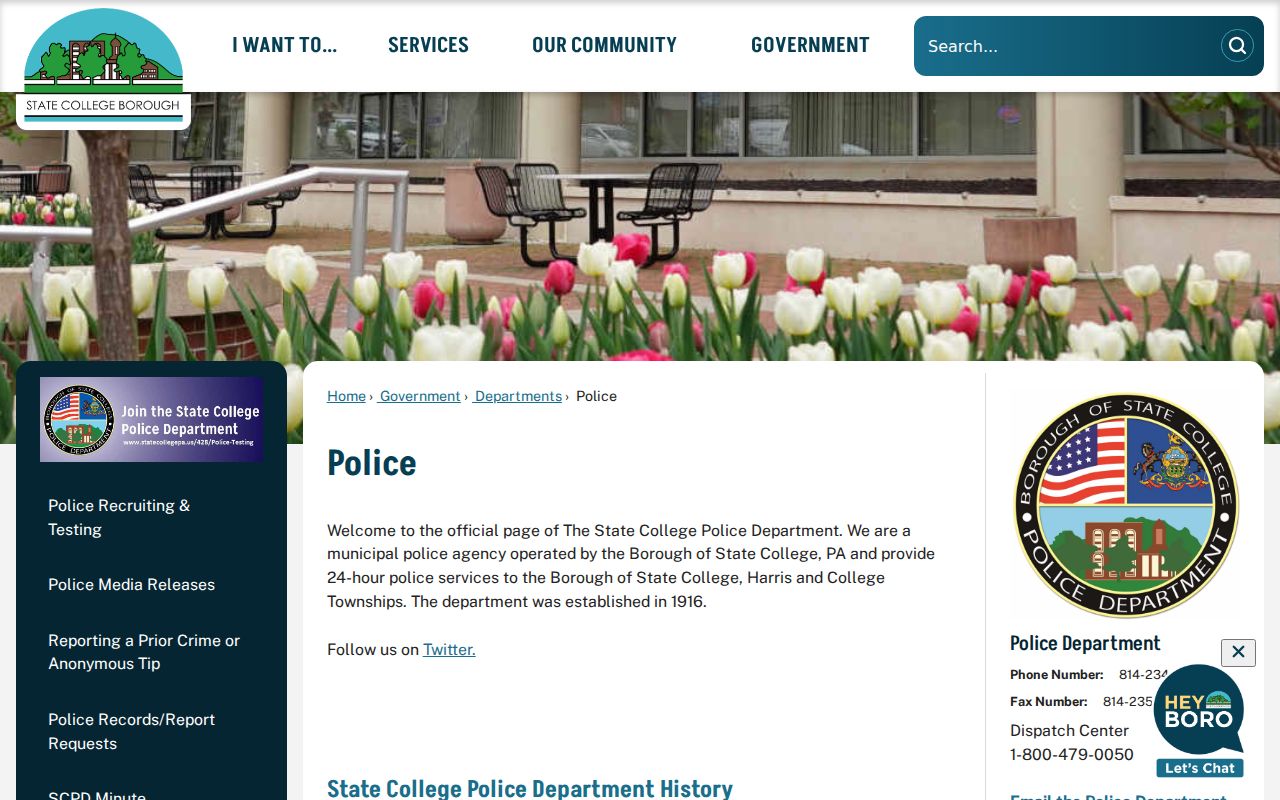
The department record remains separate from the case docket and any county booking entry created after an arrest.
State College Police Record Routes
State College uses different channels for different records. Involved parties seeking a crash report use CrashDocs. Other police records go through the borough's Right-to-Know process by email, fax, mail, or contact with the relevant officer. A crash request should not be recast as a generic RTKL request when the dedicated route applies. Likewise, CrashDocs is not the place to seek an incident narrative unrelated to a crash.
The police records and report request instructions are shown below. The source explains which local channel fits the desired record.
Provide a focused description with the date, location, involved agency, incident number, and record type. Specific requests are easier to route and redact than a demand for every record tied to a broad name.
Arrests and Bookings in State College
State College does not publish a borough arrest-name database. Four official channels cover the common questions. State College Police holds its report. UJS holds public court docket data. Centre County Correctional Facility handles county custody at 700 Rishel Hill Road in Bellefonte, and its inmate link routes to VINELink. PSP holds repository history. Each source may update on a different schedule.
An arrest requiring county custody moves from State College to central booking at Rishel Hill. The jail can be reached at 814-355-6794, and its telephone menu includes central booking. VINELink can confirm current custody by name or offender ID. It is not a historical State College arrest log. A released person may no longer appear, while the related docket may remain public unless access is restricted.
An arrest allegation is not proof of guilt. Prosecutors may amend or withdraw charges, an MDJ may dismiss a charge, and the final disposition can differ from the police paperwork. The full county process is covered in the Centre County arrest history resource.
State College and Campus Police Records
Penn State Police is a distinct custodian from State College Police. A report from University Park should not be sent to the borough merely because the mailing address says State College. Read the citation, crash exchange, complaint, or incident paperwork for the agency name. If that is unavailable, confirm jurisdiction before filing a request.
Penn State applies its own report-access process. Its research route includes eligible victim materials and a crime-victim access form, while crash requests require identification at the appropriate records counter. State College borough procedures do not control those campus records. The distinction is also useful in UJS: a participant search can locate a docket, but the police incident number and charging agency help show which office holds the underlying narrative.
State College Municipal Court Records
State College has no city municipal court. Pennsylvania's magisterial district judges perform the local first stage. They handle preliminary arraignments, bail, warrants, preliminary hearings, summary cases, and other matters allowed by law. Felony and qualifying misdemeanor charges held for court move to the Centre County Court of Common Pleas in Bellefonte.
| Court Name | MDJ 49-1-01 or MDJ 49-3-05, based on the State College address and precinct |
|---|---|
| Case Types Heard | Summary matters, preliminary criminal stages, warrants, bail, and cases within MDJ authority |
| Case Lookup Channel | UJS Case Search, the county address finder, or the correct clerk by phone or counter |
| What the Docket Shows | Charges, OTN, bail, events, counsel, dispositions, and status when publicly available |
| Copies & Fees | Ask the filing court for documents not posted online and confirm the current judicial fee schedule |
UJS searches may use docket number, participant name, organization, OTN, police incident number, or event. Choose Magisterial District Court and Centre County, then narrow by the court found from the address. A public docket index does not guarantee that every filed paper is online.
State College Court Weather Rule
MDJ 49-1-01 occupies the ground floor of the Fraser Street Parking Garage near the elevators. Its page also states a rare local scheduling rule tied to Penn State: certain hearings and summary trials may be canceled when University Park classes are canceled. A posted temporary lunch closure may occur due to staffing.
Call the court before traveling when severe weather or a class cancellation affects the area. Do not assume that an online docket instantly reflects a same-day closure. Parking terms can change, so the research does not promise free or validated parking. These practical checks can prevent a missed counter visit without changing any filing deadline set by the court.
State College Police Record History
State College's police record system grew from a much smaller local force. The borough incorporated in 1896 and appointed its first high constable that year. Its first full-time uniformed officer began in 1916 at $60 per month and reportedly walked 30 to 35 miles each day. Later patrol tools included a Ford coupe and Indian and Harley motorcycles. Those details come from the borough's official police history and give useful context for historical or genealogy research.
Old State College material may not follow today's digital request path or present department structure. A researcher should give the records office a date range, address, event type, and any known officer or case reference. For a filed criminal proceeding, pair the historical agency inquiry with the proper MDJ or Common Pleas docket. The police history does not turn activity counts into court outcomes, and a later docket remains the better source for disposition.
Where State College Records End Up
A State College incident starts with the investigating agency. When an arrest is fingerprintable, booking personnel transmit the event to the PSP Central Repository with identifiers such as the OTN. The MDJ records the preliminary stage. Charges held for court move to Common Pleas, where the Clerk keeps the criminal file. Courts and criminal justice agencies report dispositions back to PSP.
Record flow: State College Police › Centre County Courts › Pennsylvania State Police Central Repository
Recent details may appear first in the police or court file. Current custody belongs to the jail channel. PATCH is a statewide Pennsylvania certificate, not the local narrative. Someone reviewing a complete personal repository history should use PSP's Individual Access and Review process because an ordinary public PATCH result has a different scope.
State College Investigative Record Appeals
A State College RTKL request may be sent by email, fax, mail, or the stated borough process. The borough Right-to-Know page is the controlling local source for the current officer, form, and delivery options.
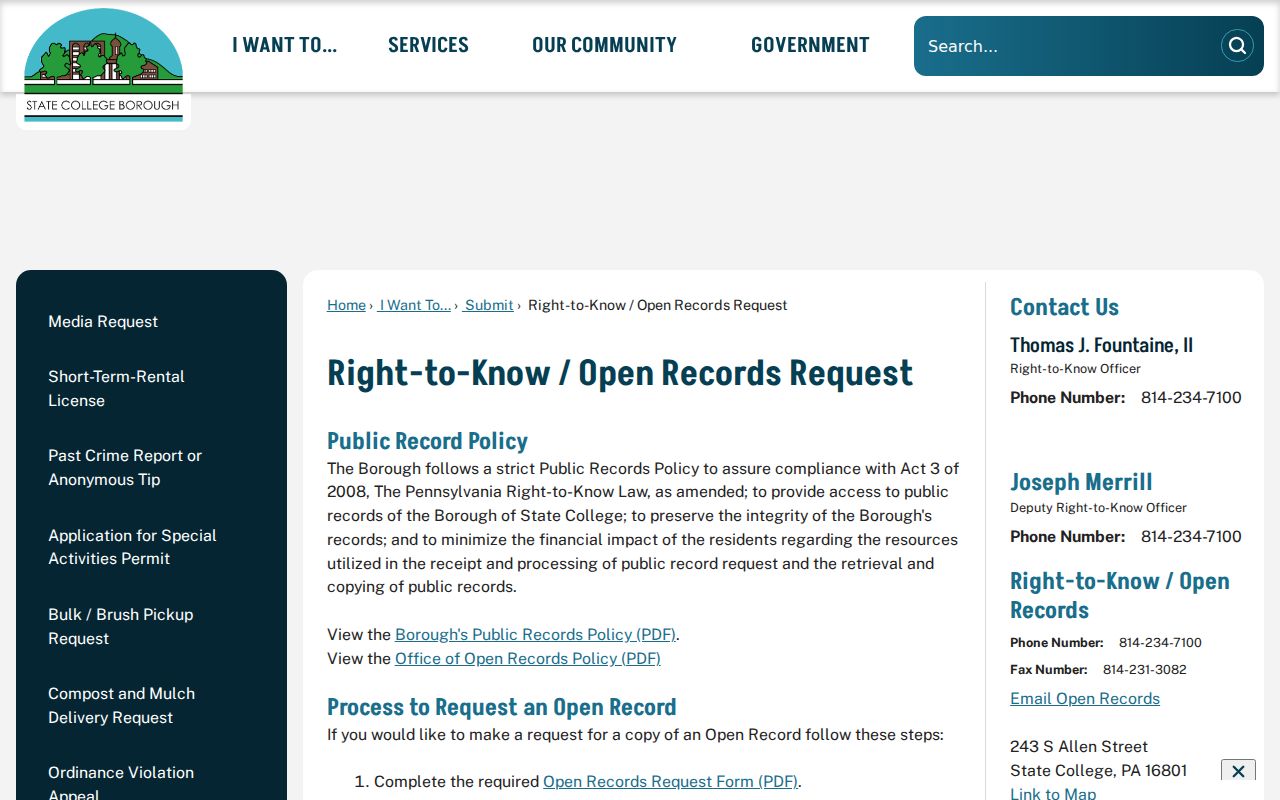
The captured instructions matter because appeals involving criminal investigative records go to the Centre County District Attorney, not the ordinary Office of Open Records route. Follow the denial notice and current deadline. The research identifies a 15-day appeal route, so preserve the response, request, and proof of delivery.
Public Access Rules for State College Records
Public access depends on the custodian and record type. The RTKL presumes many local agency records public but recognizes exemptions, privileges, court orders, and other-law limits. Police investigative material can be withheld or redacted. Law-enforcement audio and video follows Pennsylvania Act 22, which uses a separate request process and deadlines. Court cases follow the UJS Public Access Policy rather than normal borough RTKL administration.
Key Statutes:
Pennsylvania Right-to-Know Law sets the local agency request framework and ordinarily requires a written response within five business days.
18 Pa.C.S. § 9121 limits public dissemination of criminal history, including qualifying stale arrests and limited-access material.
UJS Case Records Public Access Policy governs public court files and excludes sealed, expunged, juvenile, confidential, and limited-access matters.
Ask for segregable public portions when some content is protected. Never assume that a missing online entry proves that no record exists. Verify identity and the final court disposition with the originating office.